
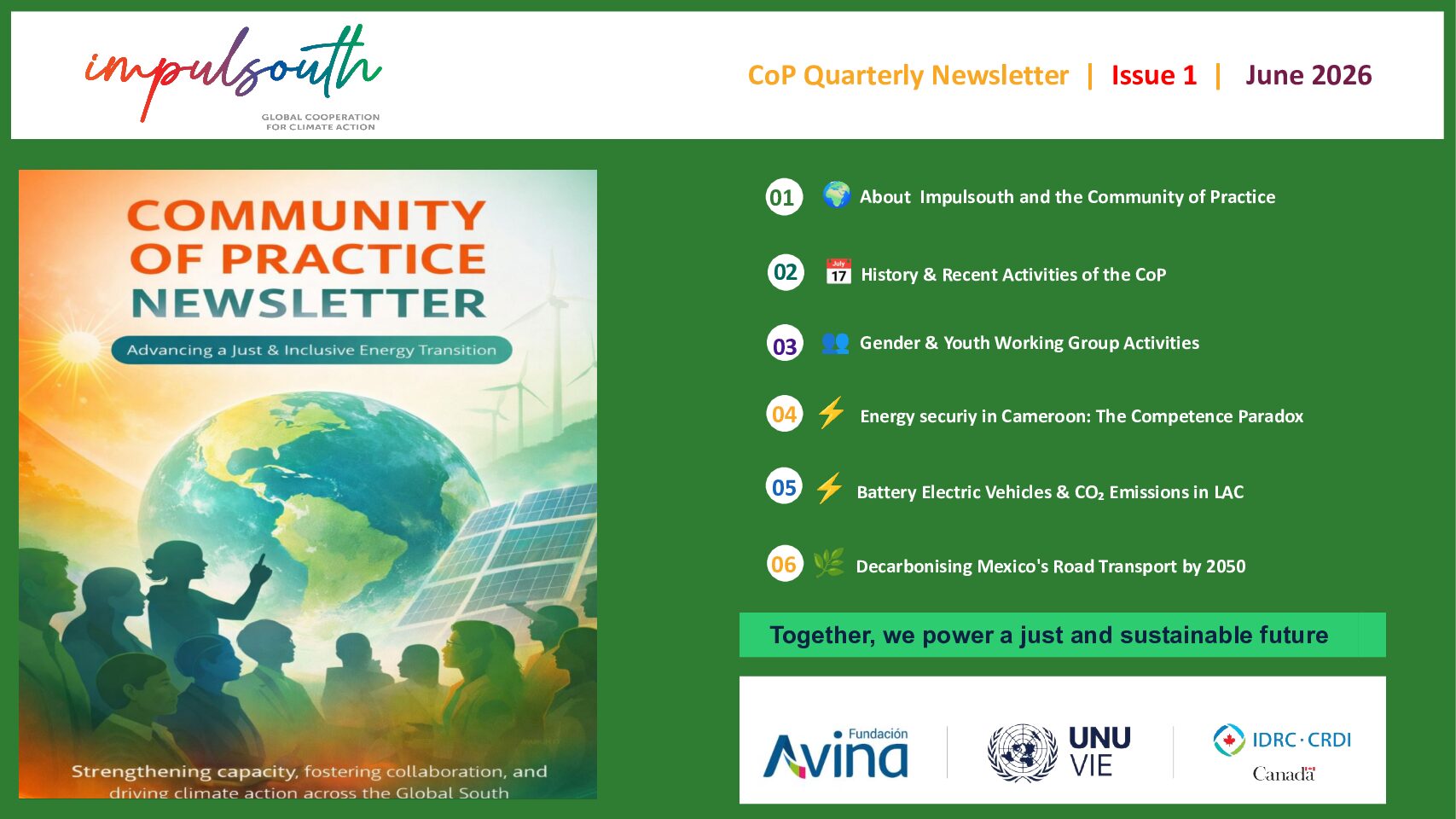
This is the Impulsouth Community of Practice (CoP) newsletter. The CoP is a collaborative platform that strengthens capacities within the energy sector, supporting a just and inclusive energy transition with a strong focus on gender equality. Bringing together diverse stakeholders, the CoP fosters knowledge exchange, strengthens institutional capacity, and promotes effective South-South cooperation across nine … Continue reading “CoP Quarterly Newsletter – Issue 1 – June 2026”
This report highlights the problem cost of capital poses for the energy transition in low- and middle-income countries, and highlights promising solutions.

This is the IEA’s annual report assessing recent trends and developments in e-mobility around the world. It looks at the deployment of electric vehicles, the expansion of charging infrastructure, battery demand, investment and policy trends and GHG emissions.
This slide deck, part of an online course, gives a brief but thorough overview of business models for off-grid solar energy, looking in particular at pay-as-you-go models, and presents insights into the investment landscape for off-grid solar companies.
This report investigates how different governments have structured their frameworks for Green Public Procurement, and presents lessons learned for practitioners interested in designing and implementing GPP reforms. It includes many country examples, including from the Dominican Republic and Ecuador.
This report by the Network of Central Banks and Supervisors for Greening the Financial System investigates the main barriers to the scaling up of blended finance for climate action in the Global South, and provides recommendations for how to address these.
This toolkit serves as a one-stop-shop to support local and regional governments to identify, design and implement renewable energy projects in public-private partnerships. It provides practical advice on: 1) the decision-making process that leads to establishment of a PPP 2) division of tasks, goals and risk management between the partners engaged in the PPP, as … Continue reading “Unlocking Public-Private Partnerships: A Toolkit for Local Governments”
The Climate Policy Initiative undertakes an annual mapping exercise of climate finance, investigating the sources, types and destinations of climate finance.
This briefing to the United Nations Commission on the Status of Women shows that climate finance flows remain largely exclusionary to women and girls. One of the reasons is that most climate finance is provided as loans, which are less accessible to women. It recommends different ways in which financing institutions can guarantee greater access … Continue reading “Gender-responsive climate finance: The key to just climate action and tackling inequalities”